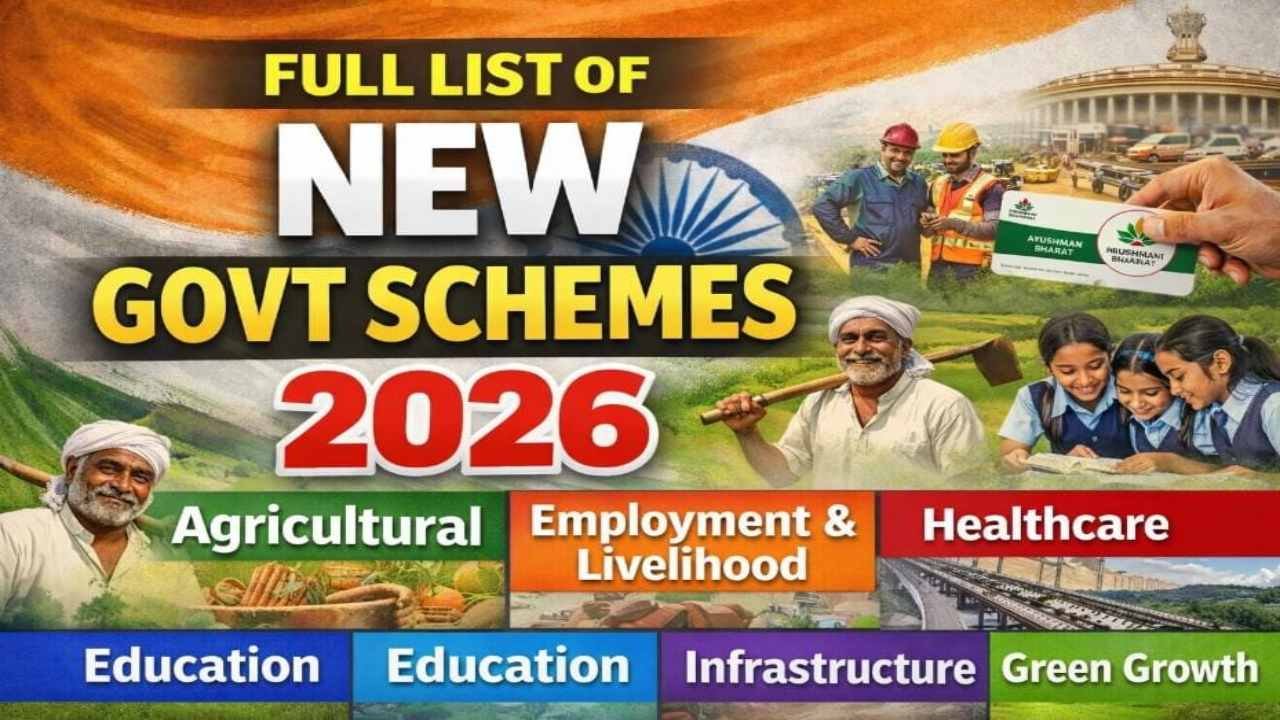
Government New Scheme 2026:Modi Government New Scheme
new government yojana 2026 india:As a Socialist Republic, India has developed a wide range of government schemes aimed at improving living standards and securing essential social and economic support for its citizens. Over the years, these schemes have quietly become part of everyday life, supporting healthcare, savings, housing, livelihoods, and social security. As we move through 2026, many of these initiatives continue to evolve, expand, and remain deeply relevant.
The Finance Minister, Smt. Nirmala Sitharaman, presented the Union Budget 2026–27 on 1 February 2026. The Union Budget 2026 proposes several new government schemes. The Union Budget 2026 government schemes cover key sectors impacting households, livelihoods, and public services.
Government New Scheme 2026
- Ayushman Bharat Yojana (PM-JAY) remains the world’s largest health insurance program. It provides health coverage of up to ₹5 lakh per family each year for secondary and tertiary hospitalization. A major update now includes all senior citizens aged 70 and above, regardless of income, making it a crucial safety net for families with elderly members.
- Atal Pension Yojana (APY) focuses on long-term retirement security, particularly for individuals without formal pension benefits. South Indian Bank supports customers under this scheme by enabling enrollment, contribution management, and ongoing account servicing, helping individuals plan for a steady pension income after the age of 60.
- Pradhan Mantri Jeevan Jyoti Bima Yojana (PMJJBY) and Pradhan Mantri Suraksha Bima Yojana (PMSBY) provide affordable life and accident insurance coverage through simple, low-cost annual premiums. South Indian Bank facilitates access to these schemes through its savings account network, supporting enrollment, premium deductions, and policy servicing.
- Pradhan Mantri Matritva Vandana Yojana (PMMVY) supports pregnant and lactating mothers with a cash benefit of at least ₹6,000, helping offset wage loss and encouraging better maternal healthcare.
- Financial Inclusion and Welfare
Several schemes aim to strengthen financial access and encourage self-reliance.
- Pradhan Mantri Jan Dhan Yojana (PMJDY) continues to serve as the foundation of financial inclusion. Through basic savings accounts offered by South Indian Bank, customers gain access to insurance, pension schemes, and direct benefit transfers, enabling wider participation in government welfare initiatives.
- Pradhan Mantri Mudra Yojana (PMMY) promotes entrepreneurship by offering collateral-free loans of up to ₹20 lakh to micro and small enterprises. South Indian Bank supports eligible borrowers under this scheme, helping entrepreneurs and small business owners access credit to start, expand, or stabilize their ventures.
- Agriculture and Rural Development
For rural households and farmers, income stability and infrastructure remain key.
- PM Kisan Samman Nidhi (PM-KISAN) provides ₹6,000 annually to eligible farmer families in three direct installments, helping meet basic agricultural and household expenses.
- Jal Jeevan Mission aims to provide safe drinking water through functional household tap connections in rural areas, improving health outcomes and quality of life.
- Pradhan Mantri Awas Yojana (PMAY), both Urban and Gramin, supports affordable housing through financial assistance, bringing the goal of “Housing for All” closer to reality.
- Skill Development and Employment
Building employable skills and supporting entrepreneurship are critical to creating sustainable livelihoods and long-term economic growth.
- Pradhan Mantri Kaushal Vikas Yojana (PMKVY) offers government-funded skill training and certification across a wide range of industry-relevant roles. The scheme focuses on short-term training, upskilling, and recognition of prior learning, helping individuals improve employability and access better income opportunities.
- Stand-Up India Scheme supports entrepreneurship by facilitating bank loans for women and SC/ST borrowers to set up new enterprises.
Modi Government New Scheme 2026
Union Budget 2026 government schemes are built around a few core priorities that guide policy decisions, sectoral interventions, and public spending for FY 2026–27.
- Economic Growth: Schemes focus on manufacturing, MSMEs, infrastructure, logistics, and services to accelerate productivity-driven growth.
- Employment and Skill Development: Government initiatives prioritise job creation through healthcare, education, tourism, creative industries, and services.
- Agriculture and Rural Livelihoods: Schemes aim to increase farmer incomes through high-value crops, fisheries, animal husbandry, and AI-based advisory systems.
- Inclusive and Regional Development: Budget 2026 targets women, youth, Divyangjan, Tier-2 and Tier-3 cities, temple towns, eastern India, and the North-East.
- Sustainability and Green Growth: Initiatives promote clean energy, sustainable transport, inland waterways, carbon capture, and eco-friendly tourism.
Full List of Major Government Schemes Announced in Budget 2026
Union Budget 2026 government schemes across key sectors will drive growth, employment, and inclusive development.
1. Agriculture & Rural Development
- Bharat-VISTAAR: A multilingual AI-based platform will integrate agricultural resources and provide customised advisory support to farmers.
- Reservoir Development Scheme: The government will support the integrated development of 500 reservoirs and Amrit Sarovars to strengthen fisheries and water resources.
- High-Value Agriculture Support: Targeted schemes will support the cultivation of coconut, cashew, cocoa, sandalwood, almonds, walnuts, and pine nuts.
- Coconut Promotion Scheme: A dedicated scheme will be implemented to enhance coconut production and productivity.
- Animal Husbandry Entrepreneurship Support: A credit-linked subsidy programme will promote entrepreneurship, modernise livestock enterprises, and expand veterinary infrastructure.
2. Healthcare
- AHP Expansion: Institutions will be upgraded and new ones established to add one lakh Allied Health Professionals over the next five years.
- Caregiver Training Scheme: The government will train 1.5 lakh caregivers with blended health and allied skills.
- Regional Medical Value Tourism Hubs: Five medical value tourism hubs will be developed in partnership with the private sector.
- Mental Health & Trauma Care Expansion: NIMHANS-2 will be established, institutes in Ranchi and Tezpur upgraded, and emergency trauma care centres strengthened at the district level.
3. Education & Skill Development
- University Townships: Five new university townships will be set up near industrial and logistics corridors.
- Girls’ Hostels: One girls’ hostel will be established in every district for higher education STEM institutions.
- AVGC Content Creator Labs: Content creator labs will be set up in 15,000 schools and 500 colleges.
- National Institute of Design (East): A new National Institute of Design will be established in eastern India.
- Education-to-Employment Committee: A high-powered standing committee will be set up to align education, employment, and enterprise growth.
4. Infrastructure & Connectivity
- Public Capital Expenditure Increase: Public capital expenditure has been increased to ₹12.2 lakh crore for FY 2026–27.
- Infrastructure Risk Guarantee Fund: A risk guarantee fund will be created to support developers and accelerate project execution.
- National Waterways Expansion: Twenty new national waterways will be operationalised over the next five years.
- Ship Repair Ecosystems: Ship repair ecosystems will be developed in Varanasi and Patna.
- Coastal Cargo Promotion Scheme: The scheme will incentivise the shift of cargo to coastal shipping and inland waterways.
- City Economic Regions Scheme: City Economic Regions will be developed with ₹5,000 crore allocated per region for Tier-2 and Tier-3 cities and temple towns.
- Seven High-Speed Rail Corridors: Seven high-speed rail corridors will be developed to connect major cities as growth corridors.
- Seaplane VGF Scheme: Viability gap funding will be provided to improve last-mile connectivity and tourism access through seaplanes.
5. Services & Employment
- SHE-Marts: Community-owned retail outlets will be established to support women-led rural enterprises.
- Divyang Kaushal Yojana: Skill development programmes will be introduced for Divyangjan in IT, AVGC, hospitality, and services sectors.
- Divyang Sahara Yojana: Support will be provided for assistive devices through strengthened ALIMCO and assistive technology centres.
6. Tourism, Culture & Heritage
- Tourist Guide Upskilling Pilot Scheme: Ten thousand tourist guides will be trained at 20 iconic tourist sites.
- National Destination Digital Knowledge Grid: Cultural, spiritual, and heritage destinations will be digitally documented.
- Eco-Tourism Trail Development: Mountain, turtle, and bird-watching trails will be developed across key regions.
- Heritage Site Development: Fifteen archaeological sites will be developed with experiential public access.
- International Big Cat Alliance Summit: India will host the summit with participation from 95 range countries.
7. Sustainability & Green Growth
- Carbon Capture Utilisation and Storage (CCUS): ₹20,000 crore will be allocated over five years for deployment across key sectors.
- Clean Energy Support: Schemes will support renewable energy and critical mineral processing.
- Green Transport Initiatives: Inland waterways, coastal shipping, and eco-friendly logistics will be promoted.
Impact of Budget 2026 Schemes on Various Sectors
The Union Budget 2026 government schemes are expected to influence growth, access, and livelihoods across major sectors.
- Agriculture: Farming households may see improved income stability, better water availability, and increased opportunities in allied activities such as fisheries and livestock.
- Healthcare: Access to healthcare services is expected to improve, especially in underserved regions, with better emergency response and care availability.
- Education & Employment: Youth may benefit from improved access to education infrastructure and clearer pathways from education to employment and entrepreneurship.
- Infrastructure: Infrastructure-led spending is expected to support economic activity, generate jobs, and improve regional connectivity.
- Green Energy: Sustainability-focused measures are likely to support India’s long-term climate goals and promote cleaner, more efficient energy use.
- Social Welfare: Targeted welfare initiatives may help improve living standards and economic participation among vulnerable and disadvantaged groups.
